

What if Pillar 2 doesn’t last?
This question set the tone for our recent network meeting in Davos — and it captures well what made this gathering different from many traditional tax events.
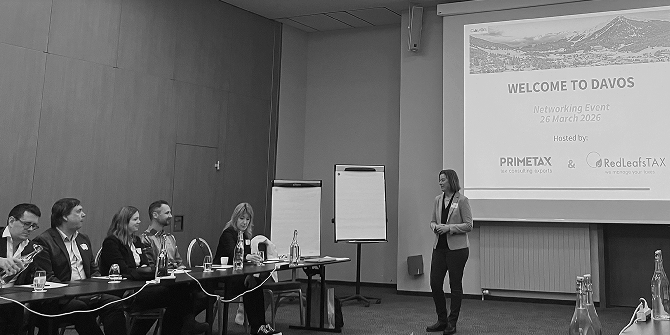
Together with PrimeTax AG, we hosted 12 independent tax advisory firms from across Europe. All participants are part of a long-standing network of trusted partners, built over many years of close collaboration on international mandates — with Red Leafs Tax actively contributing to connecting perspectives and facilitating exchange within this network.
What connects this group goes beyond technical expertise. It is a shared understanding of how we approach our work: with a strong focus on quality, integrity, and a genuine commitment to finding practical, sustainable solutions. The network is not defined by formal structures, but by mutual trust, continuity, and the ability to collaborate seamlessly across jurisdictions.
Looking beyond implementation
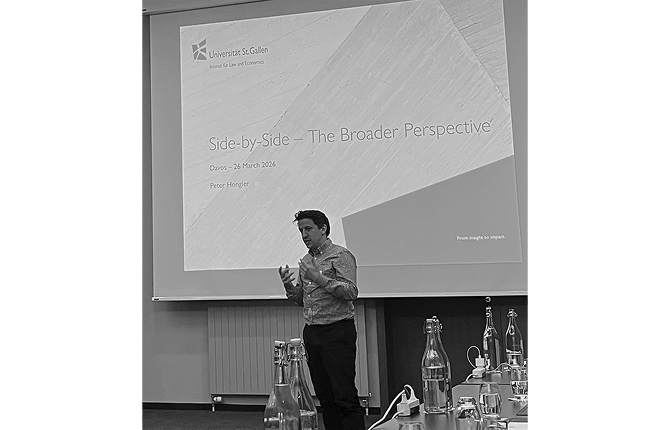
The meeting opened with a keynote by Prof. Dr. Peter Hongler, who deliberately took a step back from the day-to-day implementation debate around Pillar 2.
Rather than focusing on technical rules, the discussion started with more fundamental questions:
- What are the underlying legal tensions within the current framework?
- How robust is Pillar 2 from a structural and systemic perspective?
- And to what extent can we assume that the rules, as they stand today, will endure?
This broader perspective highlighted that Pillar 2 is not only a technical exercise, but part of a dynamic international tax environment — one that requires continuous reassessment and coordinated thinking across jurisdictions.
From big picture to practical reality
Building on this foundation, the discussion naturally shifted towards practical considerations.
The session was moderated by Barbara Hoop (Red Leafs Tax) and Patrick Scherrer (PrimeTax), creating a setting for an open and focused exchange across jurisdictions.
Barbara Hoop brought in her practical experience to highlight selected aspects of Pillar 2 that are particularly relevant from an advisory perspective, while the discussion as a whole benefited from the complementary viewpoints in the room.
Participants shared their views on incentives, implementation challenges, and how advisory firms position their services in a landscape that is still evolving.
In this context, the value of a closely connected advisory network becomes particularly clear. Many of the challenges are shared across countries — and benefit from direct exchange between practitioners who work together regularly and understand each other’s approaches.
Focused exchange across key topics
The afternoon breakout sessions continued this approach, combining technical depth with practical relevance. Each session was introduced by a short impulse presentation:
- Wealth structures and asset protection — Franz Wegscheider (Red Leafs Tax), with a focus on Liechtenstein structures
- VAT implications of crypto-related transactions — Christoph Drexl (PrimeTax)
- Appeal proceedings, mutual agreement procedures (MAPs) and arbitration — Priska Rösli (Red Leafs Tax)
- Transfer pricing considerations in M&A contexts — Patrick Scherrer (PrimeTax)
Across all sessions, the emphasis was on sharing real-world experience rather than theoretical analysis — enabled by the openness and trust within the group.
The value of collaboration
One key takeaway from the meeting is that effective international tax advisory increasingly relies on strong, trusted networks rather than isolated expertise.
Over time, this group has developed a way of working that allows for direct, efficient, and candid exchange — not only in structured settings, but also in day-to-day collaboration on client matters. Red Leafs Tax plays an active role in this ecosystem by helping to bring together the right expertise across jurisdictions and ensuring that solutions are both technically sound and practically implementable.
Many of the most valuable insights emerged in informal discussions — reinforcing the importance of continuity and trust as the foundation for high-quality advisory work.
Davos — beyond the conference room
The program was rounded off in a more informal setting, with a traditional fondue evening at the Alte Post and, for those who stayed on, a day of skiing in fresh snow.
These moments are an integral part of strengthening the relationships that underpin effective collaboration.

Acknowledgements
We would like to extend our sincere thanks to Prof. Dr. Peter Hongler for his outstanding contribution. His ability to combine academic depth with practical relevance provided exactly the kind of input that drives meaningful discussion.
We also thank all participating firms for their openness, their insights, and their continued trust in this collaboration.